

Konsol AI


Scan QR code!
🥔 Potatoes 🥔
Introduction
If you want to take this humble root fruit/root tuber to the next level, then gourmet chefs
on a professional or semi-professional amateur level expects next #level of you.
-For beginners and novices, look into traditional cuisines.
Potato Sorts
International Cuisine
There are a large number of potato varieties, including early, mid-season and late varieties. Popular varieties include folva (all-purpose), bintje (mashed), ditta (roasting), exquisa (roasting, oven) and asparagus (salad).
Early varieties
-
Soloist: Light yellow, firm to the touch and easy to peel.
-
Princess: Oval, yellow, firm and good for salad.
-
Linzer: Asparagus type, firm-boiling and good for salad.
Mid-early/late varieties
-
Folva: Firm-boiling, oval, yellow with good flavor, good for puree, soup and frying.
-
Ditta: Long oval, smooth skin, firm and good for frying.
-
Exquisa: Oval, firm-cooking and good for frying and oven.
-
Bintje: Uniform, firm and good for mash.
-
Sava: Medium-sized, uniform, good keeping quality and good for salads.
-
Hansa: Yellow flesh, firm and good for salads.
-
King Edward: White flesh, slightly floury and suitable for mash.
-
Blue Congo: Round, bluish and decorative in salads.
-
Nicola: Yellow flesh, long oval and suitable for salads.
-
Hanna: Good for mash and firm.
-
Jutlandia: Firm and good for pan-frying.
-
Hamlet: Firm and good for pan-frying.
Other varieties
-
Alouette: Deep yellow and solid.
-
Carolus: Yellow and solid.
-
Cerisa: Deep yellow and firm.
-
Belana: Firm in consistency
-
Estonia: Boiling.
-
Sieglinde: Firm and good for salad.
-
Asparagus potato: Long oval, firm and suitable for salads.
-
Egg yolk: Bright yellow, round and firm to the touch.
-
Princess Laratte: Firm and boil-proof.
Boiled Potatoes
Entry level
While boiling potatoes indoor for 18-20 min. It might take 1-2 hours outdoor for survival cooking
depending on climate and altitude.
Chefs come on fresh when it comes to boiling potatoes and might say that it took them four years to take it to perfection.
Traditionally potatoes were boiled for 20 min, but in modern cuisine more likely only for 18 min.
Peeled vs. Unpeeled Potatoes
Techniques
Potatoes with peel
Traditionally, potatoes where peeled because the peel contains a high amount of potassium.
For more details on sodium/potassium check out the Osmosis under the chemistry section, with adding salt to the potatoes to extract the potassium.
With a high amount of potassium in vegetables, only 100 g of raw vegetables per day is recommended.
With a high amount of potassium in vegetables, max. 600 g of cooked vegetables per day is recommended.
How to tournée peeled potatoes with a tournée knife (also called a bird's beak knife) is the art of plating/serving.
Chefs talk about 5-7 edges that needs to be smoothed by tournéering them around 1-1½ times.
Some would hold the knife blade vertical others horizontal.
"Peeled potatoes" refers to potatoes that have been peeled and is not a specific potato variety. It can also refer to a specific cooking technique where the potatoes are scratched around the middle before cooking so that the skin can be easily peeled off afterwards.
Peeling technique
-
Scoring: Make a light scratch in the peel around the potato with a knife. It is important to only cut through the peel and not deeper.
-
Cooking: Boil the potatoes as usual. When cooked, drain the water and cool the potatoes slightly by adding cold water.
-
Peeling: Grab each end of the potato and pull the skin off. The skin should now come off easily.
Braised vs. Sautéed Potatoes
Sliced
The first thing that comes to my mind is braised potatoes with fried eggs.
Braised potatoes vs. Sautéed potatoes
Braised potatoes cook slowly in a covered pot with liquid for tenderness and rich flavor, creating a sauce, while sautéed potatoes cook quickly in a hot pan with little fat for a crispy exterior and faster results; braising is a moist, slow method for hearty textures, whereas sautéing is a fast, dry-heat method for browning.
Braised Potatoes (Braising)
-
Method: Combines searing (optional) with slow cooking in a covered pot with liquid (water, broth, sauce).
-
Heat: Starts hot, then finishes at a lower temperature.
-
Texture: Very tender, "melt-in-your-mouth," with a built-in sauce.
-
Best For: Hearty, dense potatoes that need time to soften.
Sautéed Potatoes (Sautéing)
-
Method: Quickly cooking in a small amount of fat (oil, butter) in an open pan.
-
Heat: High heat.
-
Texture: Crispy, golden-brown exterior with a tender interior.
-
Best For: Quick-cooking, smaller potato pieces that get a nice crust.
Diced Potatoes
Danish/Swedish cuisine
The first thing that comes to my mind with diced potatoes is a Danish Biksemad.
Biksemad is a religion in Danish cuisine, made from leftover meat.
Biksemad is best translated as "hash" (as in beef hash or potato hash) or "Scandinavian hash" in English, as it is a mixture of diced, fried leftover meat (beef and pork, as well as sliced sausage pieces) and also diced potatoes, with yellow onions, fried eggs, and pickled beets.
The English equivalent is often "Bubble and Squeak," but it's primarily made from potatoes and cabbage.
Biksemad vs. Pytt i panna
Biksemad og svensk pytt i panna er i bund og grund det samme koncept: En "ryd-op-i-køleskabet"-ret bestående af tern af kartofler, kød og løg, der er stegt på panden.
-
Biksemad (Danmark): Serveres traditionelt med spejlæg, syltede rødbeder, Worcestershire sauce (engelsk sauce) og ketchup.
-
Pytt i panna (Sverige): Serveres ofte med spejlæg (eller rå æggeblomme), syltede rødbeder og undertiden syltede agurker.
Choose your Technique
The first thing gourmet chefs think of is that they should be diced into cubes of either 2×2 mm. or 4×4 mm.
Traditionally a fried egg is served together with a Danish Biksemad, some would give it a shot with a poached egg.
If served with bacon, make sure the skin on top is removed.
Serving/Plating
⅓ Diced potatoes
⅓ Leftover meat
Plating means a lot for the visual outcome. Just don't serve the fried egg on top in the middle, be creative.
Traditionally, a slice of pickled beetroot is also to be found on the side of the plate, to balance the sour with the fat.
Thyme is ultimately the best universal flavor enhancer, besides of MSG of course. Research into the relationship between MSG (monosodium glutamate) and dementia suggests that very high dietary intake may potentially accelerate Alzheimer's-like changes (e.g., via excitotoxicity) in animal studies, but direct causation in humans has not been conclusively established. Too much glutamate can overstimulate nerve cells, which could theoretically damage the brain.
For a topping finely chopped chives, also 2-4 mm in length, is an excellent, fresh topping for biksemad, balancing the heavy and fatty ingredients like potatoes, meat and fried eggs.
Typically served with HP sauce, if you want to focus on the fried egg, and/or with Worcestershire sauce, if your focal point is the technique with Braised potatoes vs. Sautéed potatoes.
-Commonly ketchup might also be used amongst bachelors, but that's not traditional, neither is garlic, but optional.
Conclusion
I had a conversation with fellow Danes, and we agree, that premade, frozen Biksemad from the supermarkets disqualifies, being tasteless and a waste of money.
Some hate Danish biksemad, others love it!
A Danish Biksemad requires a trinity/square of skills △
1. Braised potatoes vs. Sautéed potatoes
4. Skills with accessories/condiments
5. Skills with plating
Sliced Potatoes
Entry Level
Swedish Sausage Dish
Swedish sausage dish is actually a Danish recipe, that has no origin in Swedish cuisine.
It's a matter of fact that no one in Sweden have ever heard of it.
Kitchenware

A copper sauté pan with lid.
Copper heats fast and cools fast, ideal for a saucepan.
To sauté means to lightly brown a food in fat for a short time over medium or high heat in a pan or pot.
The term is most often used for raw materials that have been cut up, e.g. vegetables in slices or sticks.
A sauté pan is also used for spaghetti bolognese.
A sauté pan can also substitute the need for a wok pan/pot if you don't have a gas stove.
Ingredients
(1 portion)
Traditional
½ glass of pre-boiled potatoes (200g)
2 Wiener sausages, chopped
½ -1 yellow onion
3 Tbsp. olive oil
¾ Tsp. Edelsüß paprika (mild)
2 Tsp. concentrated tomato paste (70g)
2 dl whole milk
¼ Tsp. coarse salt
Freshly ground pepper
Topping
Freshly chopped chives
Optional
1 Tbsp. Vinegar
75 g carrots
⅛ cucumber
Steamed broccoli or cauliflower
Peas
Celery
¼ garlic clove
A pinch of chili
½ Tbsp Ketchup
Philadelphia cheese instead of heavy cream
Tip: Glass potatoes are both peeled and pre-cooked, which makes them easier to slice,
and they only need to be heated for a few minutes.
Procedure
1. Peel and chop onion. Cut sausages and preboiled potatoes into small pieces.
2. Let the oil or butter turn golden in a sauté pan and sauté the onion for 1 min.
3. Add sausages and paprika. Sauté at middle-high temperature for 3 min.
4. Reduce heat to medium. Add pre-boiled potatoes, tomato paste and the remaining ingredients.
5. Reduce the heat to minimum and let the dish simmer for 8 min. until the dish is hot and the consistency adjusted with whole milk.
6. Garnish with chopped chives and serve.
How to cook Stockholmare
.jpg)
Swedish Stockholmare
(Local Shopping: First seen in Lidl)
This is an experiment, traditionally Wiener sausages are used.
Contains both pork and beef, as well as garlic and a high salt content of 2.3%.
Smoked with red Alder. Alder ensures a milder aromatic smoking, alder is easier to smoke, you avoid too much smoking. Alder is a really good type of wood for smoking fish and meat; Alder gives a more delicate flavor when smoked. However, smoking is not for the sake of flavor, but a way to preserve meat and fish, just like salt.
To cook Stockholm sausage (potatis korv), prick it, then boil in water until firm, about 30-45 min. for a whole coil. Next, brown the boiled sausage in a pan with a neutral oil or in a 205°C/400°F oven until crispy. Slice and serve with a strong, coarse mustard and possibly with other Swedish root vegetables and bread, such as boiled potatoes.
Preparation
-
Prick: the sausage with a fork to prevent bursting.
-
If the sausage is very long, you can tie off the ends with butcher's twine to hold its shape during cooking.
Cooking Methods
-
Boiling (Poaching)
-
Cover the sausage with water in a large pot.
-
Bring the water to a boil, then reduce it to a gentle simmer.
-
Cook for about 30-45 minutes, or until it's slightly firm and pale.
-
-
Browning (after boiling)
-
Pan-Frying: After boiling, transfer the sausage to a pan with a bit of neutral oil.
-
Baking: Alternatively, place it on a greased, rimmed baking sheet in a 205°C/400°F oven for about 15 min. flipping halfway through, until the exterior is browned.
-
Serving
-
Slice the cooked sausage into desired lengths.
-
Serve with a strong, coarse mustard, which is a traditional accompaniment.
-
It pairs well with other Swedish root vegetables and bread.
Main Ingredients

Swedish sausage dish prerequisites
No heavy cream, but whole milk preferably.
Make the main ingredients fill the plate for 1 portion.
Whenever chefs say to take out the main ingredients of the fridge 15 min. before, I say minimum 2 hours, preferable two days before! Let those bacteria cultivate for your taste of preference.
Use the amount of milk to compensate for the consistency of the amount of concentrated tomato puree.
Another Swedish specialty is Falukorv a thick emulsified sausage in the Falun red color.
In Sweden, Falu refers to Falu Rödfärg, or Falu Red, a traditional, deep red paint made from
a byproduct of the Falun copper mine. If you've ever visited Sweden, you'll have noticed that a lot
of cottages and houses are painted in the Falun red color, which is also the color of this delicious sausage.
Danes love it, but I've never seen it available in the local supermarkets.
Backed Potatoes
Danish Cuisine
Large potatoes are sold as baking potatoes and are cooked with the skin on in the oven.
Finally, a cut is made in the top and sour cream with chives is added in the cut.
Baked potatoes go perfectly with chicken, chops (a cut of meat cut from the tenderloin of veal, lamb or pork), roast beef or a juicy coulotte roast. It's their versatility that makes them so popular. Surprisingly, baked potatoes require tons of butter and coarse salt. But the most important element comes first when serving.
Hasselback
Swedish Cuisine
Hasselback potatoes are the correct term, not Hassel backed potatoes. Also known as Accordion potatoes in English.
The dish is named after the Swedish restaurant Hasselbacken in Stockholm, which dates back to the 18th century. The idea of the ¾-cut, oil- or butter-baked baking potatoes is said to have originated in the 1950s, as it allowed for faster baking.
Tip: You can place two chopsticks on each side of the potatoes to avoid cutting them too deep.
Serving
Typically sprinkled with coarse salt on top.
Scalloped Potatoes
Creamed Potatoes
(Forbidden Tech)
Another forbidden tech is a heavy creamy Danish cauliflower soup.
Mixing heavy cream with stomach acid is like mixing oil with water.
Caramelized Potatoes
Danish Cuisine
Caramelized potatoes are traditionally served on both Christmas and New Year's Eve in Denmark.
In Danish caramelized potatoes are called brown or browned potatoes.
Technique
The main thing is to get the temperature right in the pan when melting the sugar.
If the temp. is too low the sugar won't bind to the potatoes, so they won't get that golden brown color.
If the temp. is too high the caramel will start to coagulate and not given them that smooth surface.
Tip
Remember to pat the potatoes dry with a piece of kitchen paper before putting them on the pan, otherwise it will splatter all over the place and you have to wipe it off immediately before the sugar solidifies, which will require more time and effort to clean up afterwards.
Asparagus potatoes are suitable for caramelized potatoes because of their firm consistency. However, glas conserved potatoes are also suitable as you can save time by not having to peel them first.
Recipe
Brunede kartofler - Opskrift på perfekte brune kartofler | Arla
Mashed Potatoes
Danish/Swedish Cuisine
Note: In American and Canadian English, the term "mashed potatoes" is preferred, whereas in the UK, it is often simply called "mash".
Swedish Cuisine
Potatismos med korv
Classic Scandinavian dishes with mashed potatoes are traditionally served together with:
-
Fläskfärs (Wallenbergare/krebinetter/karbonader/pork patty)
-
Gulasch (gullasch or gullash in Danish)
-
Diced bacon the Danish way (brinnande kärlek in Swedish)
-
Sausage the Swedish way (traditionally served on Swedish bistro/grill bars)
Danish Cuisine
Brændende kærlighed
Mashed potatoes with diced bacon and onions fried in the bacon fat often served with pickled beets
and sprinkled with chives or parsley called 'Brændende kærlighed' is a traditional Danish dish.
Mashed potatoes with lots of real butter, not spreadable butter mixed with oil, served with diced bacon and drizzled with bacon fat on top in a lake made by a recess in the top of the mashed potatoes that runs down the sides. In modern cuisine that's a nutritional no go. Some recommends drying the fried bacon on a piece of kitchen paper. My purchased peeled potatoes have been allowed to get old, tender and sprouting, because mashed potatoes is a traditional poor man's dish to avoid wasting food.
Onions
Traditionally yellow onions are used, but some would give it a shot with shallot onions for a more French style.
The beets come sliced premade from the supermarkets.
Lately, I've discovered that some would dice them in the same cubic metrics as the diced bacon and serve the beets as a topping
and not on the side.
In that the case, I would recommend drying the diced beets piece of kitchen paper, because the colors of the mashed potatoes and the beets is not exactly a beautiful plating for final serving.
Væltet Lokum
"Væltet lokum" is a slang term for the Danish dish Millionbøf, so in English it would be "Minced meat with gravy", "Sloppy Joe" (if with bun), or a description like "Cottage Pie" (if with mashed potatoes) – it doesn't have a direct translation as it refers to the Danish dish, but the concept is minced meat with gravy and potatoes/pasta.
'Millionbøf' is best translated as "Million Beef" or "Million Steaks", as it literally means 'million beef' or 'million steaks', because the meat is broken up into many small pieces, like a kind of Danish staple that resembles a steak in 'a million small pieces', often served with mashed potatoes and pickles, and can be seen as a variation of the English "Cottage Pie" if baked with mash on top.
Million beef is traditionally served with soft mashed potatoes.
The name of the dish refers to a stew that looks like something poured from a bucket.
However, I would probably prefer the potatoes cut into bite-sized pieces and only cooked a la dente (eat coarsely).
The color of the ready-made sauce changed over time, and nowadays can only be considered as ammoniated caramel, without any form of flavor enhancer, and we are back again to having to master how to make a brown pan sauce that separates on the plate, reminiscent of how a thick sauce changed character over time to be on the verge of being a thin layer of soup, and thus a Danish "sovs" became a sauce.
-When it comes to freshly grounded pepper, let it rain!
Another trend which is not Scandinavian is to use mashed potatoes for potato donuts with raspberry jelly.
Mashed potatoes are also used for making hot dog potato buns with the same intend as Brioche hot dog buns using eggs which is to keep the hot dog buns fresh for as long as possible to meet the supermarkets demands for an on-demand culture.
While onto what mashed potatoes can be used for, you might look into a classic British shepherd's-pie with grated Parmesan cheese on top.
French Cuisine
Pommes Purée
Pommes purée is a French, ultra-refined version of mashed potatoes designed to be incredibly smooth, buttery, and creamy, often passed through a sieve to remove all lumps. While they share the same base, regular mashed potatoes are often rustic and chunky, whereas pommes purée is far richer due to a much higher butter-to-potato ratio.
Joël Robuchon’s famous Pommes Purée are renowned for their ultra-creamy, silken texture, achieved using a 2:1 potato-to-butter ratio (specifically Ratte, Yukon Gold, or Russet potatoes). The technique involves boiling potatoes whole, peeling while hot, passing them through a ricer, drying them over heat, then vigorously whisking in cold, cubed butter and hot milk.
Italian Cuisine
While onto mashed potatoes you might also want to look into Italian potato Gnocchi.
Mashed Sweet Potatoes Recipes?
Potato Risotto. "Kartoffelotto" is a dish that combines ingredients from potatoes and risotto. It is typically made by simmering cubes of firm potatoes in broth with vegetables such as onion and garlic, adding white wine and possibly cream cheese or parmesan cheese for a creamy texture.
Technique
Mashed potatoes are an old-fashioned recipe for potatoes that are past their best-before date. Fresh potatoes won't do!
Take the potatoes out of the refrigerator and store them at room temperature for a couple of weeks before cooking.
Boiling potatoes makes gourmet chefs getting overwhelmingly critical.
Overcooked potatoes are not good unless they are specifically to be used for mashed potatoes.
The key to make a successful mashed potato is a lot of butter to give it a smooth texture.
But lots of butter makes it heavy, so whisk it a lot to get air into it to make it fluffy.
Plating a dish with mashed potatoes can be formed as a quenelle.
There're two techniques, either with one or two tablespoons to do so.
-Do not start to mash the potatoes before they're fully cooked for about 20 minutes!
Farserede Porrer
Danish Cuisine
"Farseret porre" translates to stuffed leeks in English, where you wrap a minced meat or vegetable filling (fars, pork/veal) around a blanched leek, often then baking or frying them, similar to a wrapped dish, and served with potatoes.
Another option is to slice the leek and mix it into a typical Danish meatball stuffing (frikadellefars).
Gourmet chefs dread having to prepare leeks; they themselves are very critical about how the leeks get the right bite and that they don't overcook or undercook them. The primary criterion is that the leek is tender.
Benløse Fugle
Danish Cuisine
Boneless Birds served with potatoes or mashed potatoes
In English, "boneless birds" are typically called Beef Olives or Veal Birds, which refer to small, stuffed beef or veal rolls that look like small birds, but are not real birds, often made with a filling of lard, onion and herbs, a bit like Italian braciole or French oiseaux sans tête.
Boneless birds is a myth about a day-old blackbird that has been left to soften in the sun, so that its legs were easy to tear off. But of course, it has nothing to do with blackbirds, budgies, geese or ducks. Boneless birds are made of beef.
About as much a myth or legend as Forloren hare (meatloaf) and Forloren tortoise. Forloren means inauthentic, fake or artificial and is typically used for a dish that imitates a more expensive or more exclusive dish but is made from cheaper ingredients.
Skrædderduelse
Southern Jutland Cuisine
'Skrædderduelse' is a regional dish from Southern Jutland, Denmark consisting of potatoes and smoked pork with a mustard sauce as a dip, called "duelse". Originally a sparing dish for poor people, personified by a tailor, where tailor duelse mean poor man's dip.
There are no butchers/supermarkets that market the term smoked pork.
So, are smoked pork and smoked bacon the same thing?
According to an AI query, smoked pork and smoked bacon are essentially the same product, as bacon is smoked breast meat. Both come from the breast of the pig and are salted and smoked. The difference lies primarily in the cut and thickness: Bacon is often thinly sliced, while smoked pork can be in thicker slices or pieces. Smoked pork cubes are browned and sliced onions are added.
Serving
Served with one or two 'dirty eggs'.
The difference between 'smiling eggs' and 'dirty eggs' is that if the dish is served with a mustard sauce (basic roux-based, white béchamel sauce with mustard), then the 'smiling eggs' are called 'dirty eggs', both commonly known as 'Jammy Eggs'.
A perfect dish for serving with pickled beetroots, which has a lot of health benefits.
Rösti
Swiss Cuisine
Luxembourgish: Rööschti (meaning shaped as a rose)
German: Reibekuchen (meaning grated cake) or Kartoffelpuffer (potato pancakes)
Similar to American Hash Browns (grated fried potatoes)
Formed as patties 5"-inch in diameter and 1"-inch thick like a Danish Hakkebøf.
For the edges to get golden and crisp a confit with tons of butter is recommended.
Traditionally served as breakfast with spinach and a fried egg sunny side up and sometimes with grated cheese as in an omelet.
Restaurants serve them as a side dish.
If sliced onions go into the Rösti, carefully assure that they don't appear on the surface, or they will get burned before the Rösti gets golden-brown and crispy.
Tons of salt goes into compound, as the potatoes deserve like so many dishes.
-Similar to Rösti is Korean Potato Jeon (Gamja-jeon (감자전).
Kitchenware
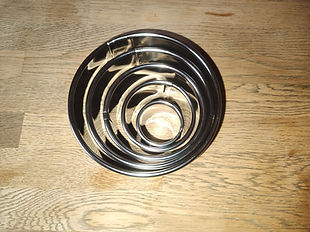
Stainless steel ring molds
Can be used to shape Rösti and also to press out cylindric Pommes Fondant.
Confit Potatoes
French Cuisine
Confit potatoes are a dish of potatoes slowly cooked while completely submerged in fat (such as olive oil, duck fat, or butter) at a low temperature (93-125°C / 200-275°F). This French technique results in an incredibly tender, creamy interior and a rich, lightly golden exterior, often described as luxurious, velvety, and buttery.
Key Characteristics of Confit Potatoes
-
Cooking Method: Unlike deep-frying, confit involves poaching at low heat, which avoids intense browning while infusing the potatoes with flavor.
-
Texture: They become very soft, creamy, and sometimes melt-in-the-mouth, rather than intensely crispy like roasted potatoes.
-
Fat Used: Typically, olive oil, garlic-infused oil, or rendered duck/goose fat is used to add deep flavor.
-
Origins: Derived from the French word confire ("to preserve"), it is a traditional method originally used to store meats in fat.
-
Preparation: Potatoes are usually peeled, seasoned, covered in fat, and cooked in the oven for 45 minutes to 2 hours.
They are often considered a refined, restaurant-quality side dish that can be served directly or finished with a quick sear for extra texture.
Potatoes au Gratin (Dauphinoise)
French Cuisine
Gratin is a French dish prepared in an ovenproof dish (or baking pan) in the oven. In the French tradition, breadcrumbs and cheese are placed on top of the dish, which gives it a crispy and golden surface after cooking. The word is derived from the French gratter, which means to scrape or scratch and refers to the fact that the dish traditionally consists of leftovers from the previous day's meals.
A gratin can be made from cheese, meat, vegetables and fish, poured over with a milk sauce such as a béchamel sauce to which eggs have been added. The mixture is covered with cheese, breadcrumbs or breadcrumbs, which are then coated with butter and baked in the oven until the gratin has a crispy, brown surface.
Potato, Brussels sprout and cauliflower gratin are good examples, but there are countless options and variations, like potato gratin with Porcini mushrooms (in Danish, Karl Johan). Cheese can be omitted.
Potato Pavé
Similar to Gratin Dauphinois
Potato pavé is a luxurious potato dish consisting of thin slices of potato layered with cream and butter, baked, pressed flat and finally fried until crispy (often deep-fried). It offers a crispy surface and a creamy, tender core. The dish is baked in a mold, cooled under pressure overnight and cut into cubes.
Potato Pavé vs. Potato Dauphinoise
Potato pavé is a dense, high-effort, multi-day dish involving thinly sliced potatoes layered in a loaf pan, baked, weighted overnight, cut, and fried until crispy, yielding a rectangular "brick" with creamy layers. Dauphinoise is a simpler, traditional rustic casserole of thinly sliced raw potatoes baked in cream, garlic, and butter until bubbly.
Pommes Croquette
French Cuisine
A croquette is a deep-fried roll originating in French cuisine, consisting of a thick binder combined with a filling, which is then breaded. It's served as a side dish, a snack, or fast food worldwide.
French Cuisine
Pommes Anna, eller Anna-kartofler, er en klassisk fransk ret af skivede, lagdelte kartofler kogt i en meget stor mængde smeltet smør. Der findes flere varianter af retten, der udover kartofler og smør indeholder andre ingredienser, som kan omfatte artiskokhjerter, sorte trøfler, svampe og ost.
Pommes Fondant
French Cuisine
Fondant potatoes, or pommes Fondant (French for 'melting potatoes'), is a method of preparing potatoes that involves cutting them into cylinders, browning the ends, and slowly simmering in butter and stock.
Pommes Fondant are most commonly served alongside high-quality red meats, roasted poultry, and rich sauces. Because they are crispy on the outside, velvety-soft on the inside, and rich with butter and herbs, they function as an elegant side dish for fine-dining entrées.
The most classic and popular pairings include:
Premium Meats
-
Steak: Pan-seared ribeye, filet mignon, Chateaubriand, or bavette steak.
-
Roast Beef: Thick slices of slow-cooked roast beef, prime rib, or tender beef brisket.
-
Lamb: Roasted leg of lamb, grilled lamb chops, or cannon of lamb.
-
Game: Venison, pheasant with wild mushroom sauce, pigeon, or roast partridge.
Poultry & Pork
-
Roasted Chicken: Crispy roast chicken breast, chicken supreme, or classic French Chicken Chasseur.
-
Duck: Duck breast served with orange or blackberry reductions.
-
Pork: Herb-crusted pork loin, pork confit, or slow-cooked pork casseroles.
Pommes de Terre Sautées
French Cuisine
Pommes de Terre Sautées
This bistro classic is commonly seen on French menus as a side dish for main “plats” like confit de canard, entrecôte, and so much more. The potatoes are always served hot and extra crispy.
Amongst the same with other names are gommer fries, house fries, stegte kartofler, bratkartoffeln eller bistrokartofler.
Could be served together with a Wienerschnitzel.
Potato Salads
Grill Season
Danish vs. German Potato Salad
German potato salad is generally served warm with a tangy bacon-vinegar dressing, while Danish potato salad is typically served cold with a creamy yogurt or mayonnaise-based dressing. German versions emphasize vinegar and savory bacon, whereas Danish versions are often lighter and paired with fresh herbs like chives or dill.
German Potato Salad
-
Temperature: Served warm or at room temperature.
-
Dressing: Vinegar, broth, bacon drippings, mustard, and sugar (no mayo).
-
Key Ingredients: Bacon (Speck), onions, and waxy potatoes.
-
Regional Note: Southern Germany prefers the warm/vinegar method, while Northern Germany often uses mayonnaise.
-
Flavor Profile: Tangy, smoky, and acidic.
Danish Potato Salad
-
Temperature: Served cold.
-
Dressing: Usually a mixture of crème fraîche, sour cream, or mayonnaise.
-
Key Ingredients: Potatoes, chives, radishes, and sometimes sour cream.
-
Flavor Profile: Creamy, fresh, and often mild.
During the grill season in Denmark a potato salad is a mandatory serving together with grilled steaks and sausages.
A cold potato salad also goes well for lunch served with lukewarm 'frikadeller' (Danish meatballs).